
Why Does the Y Chromosome Retain UTY?
2026.05.19
The study captures a possible evolutionary transition of a fading Y chromosome gene
Researcher(s):Tomohiko Akiyama
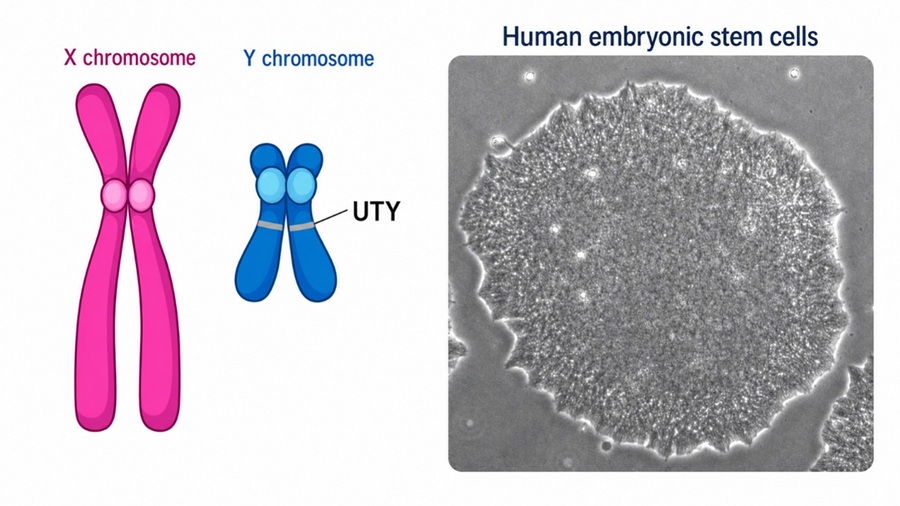
Researchers at Yokohama City University, Japan, have uncovered evidence that the Y chromosome gene UTY still retains regulatory activity in human embryonic stem cells, offering a rare glimpse into what may represent an evolutionary transitional state of the human Y chromosome.
The study, published in Volume 153, Issue 9 of the journal Development on May 14, 2026, by The Company of Biologists, is the first to precisely map endogenous UTY occupancy across the human genome and demonstrate that UTY remains functionally involved in transcriptional regulation during early human development.
The human Y chromosome has lost many of its ancestral genes over millions of years of evolution. Yet a small number of genes, including UTY, have been evolutionarily retained despite their weak expression and reduced enzymatic activity. Why these genes persist has remained a longstanding question in chromosome biology.
To investigate this, the researchers generated human embryonic stem cells carrying endogenous 3×FLAG-HA tags in UTY and its X chromosome homolog, UTX, using CRISPR-Cas9 genome editing. Combined with dual-crosslinking ChIP-seq, this strategy enabled high-resolution detection of UTY localization across the genome—something that had previously been technically difficult because of UTY’s low expression and the limited performance of available antibodies.
The researchers found that UTY co-occupies active cis-regulatory elements together with UTX and contributes to the proper localization of pluripotency-associated transcription factors, such as OCT4 and SOX2. At the same time, however, UTY occupancy was substantially weaker and less extensive than that of UTX.
Rather than demonstrating that UTY functions as a fully independent regulator, the findings suggest that UTY retains a partial and possibly diminishing regulatory role alongside UTX.
“This may represent a snapshot of an evolutionary transition,” says Dr. Tomohiko Akiyama, an Assistant Professor at Yokohama City University, Graduate School of Medicine, Japan. “UTY is still functional, but its expression and genomic occupancy are considerably lower than UTX. It is possible that we are observing a gene that is in the process of evolutionary loss, yet still retains residual biological function.”
The study also showed that the combined disruption of UTX and UTY altered transcription factor localization and destabilized pluripotency without causing major global changes in H3K27me3, indicating that the proteins cooperate through largely non-catalytic chromatin regulatory mechanisms.
The findings suggest that some Y chromosome genes may continue to retain residual regulatory functions long after much of the chromosome has undergone degeneration during evolution.
The work provides a new perspective on Y chromosome biology—not as a static genetic structure, but as a chromosome potentially undergoing continuous functional transition even in modern humans.
The human Y chromosome has lost many of its ancestral genes over millions of years of evolution. Yet a small number of genes, including UTY, have been evolutionarily retained despite their weak expression and reduced enzymatic activity. Why these genes persist has remained a longstanding question in chromosome biology.
To investigate this, the researchers generated human embryonic stem cells carrying endogenous 3×FLAG-HA tags in UTY and its X chromosome homolog, UTX, using CRISPR-Cas9 genome editing. Combined with dual-crosslinking ChIP-seq, this strategy enabled high-resolution detection of UTY localization across the genome—something that had previously been technically difficult because of UTY’s low expression and the limited performance of available antibodies.
The researchers found that UTY co-occupies active cis-regulatory elements together with UTX and contributes to the proper localization of pluripotency-associated transcription factors, such as OCT4 and SOX2. At the same time, however, UTY occupancy was substantially weaker and less extensive than that of UTX.
Rather than demonstrating that UTY functions as a fully independent regulator, the findings suggest that UTY retains a partial and possibly diminishing regulatory role alongside UTX.
“This may represent a snapshot of an evolutionary transition,” says Dr. Tomohiko Akiyama, an Assistant Professor at Yokohama City University, Graduate School of Medicine, Japan. “UTY is still functional, but its expression and genomic occupancy are considerably lower than UTX. It is possible that we are observing a gene that is in the process of evolutionary loss, yet still retains residual biological function.”
The study also showed that the combined disruption of UTX and UTY altered transcription factor localization and destabilized pluripotency without causing major global changes in H3K27me3, indicating that the proteins cooperate through largely non-catalytic chromatin regulatory mechanisms.
The findings suggest that some Y chromosome genes may continue to retain residual regulatory functions long after much of the chromosome has undergone degeneration during evolution.
The work provides a new perspective on Y chromosome biology—not as a static genetic structure, but as a chromosome potentially undergoing continuous functional transition even in modern humans.
Reference
Title of original paper: Functional redundancy between UTY and UTX in regulating the localization of transcription factors involved in pluripotency
Journal: Development
DOI: 10.1242/dev.205328
Journal: Development
DOI: 10.1242/dev.205328
Additional information
Latest Article Publication Date: 14 May 2026
Method of Research: Experimental study
Subject of Research: Not Applicable
Conflicts of Interest Statement: The authors declare no conflicts of interest.
Method of Research: Experimental study
Subject of Research: Not Applicable
Conflicts of Interest Statement: The authors declare no conflicts of interest.
Funding information
This work was supported by grants from the Japan Society for the Promotion of Science (JSPS) Grant-in-Aid for Specially Promoted Research (JP19K06492, JP20H05395, JP20H04929, JP22K06090, and JP22H04699).
This work was supported by grants from the Japan Society for the Promotion of Science (JSPS) Grant-in-Aid for Specially Promoted Research (JP19K06492, JP20H05395, JP20H04929, JP22K06090, and JP22H04699).
For inquiries regarding this article
Tomohiko Akiyama
Associate Professor
Department of Molecular Biology, Yokohama City University, School of Medicine, Yokohama, Japan
Associate Professor
Department of Molecular Biology, Yokohama City University, School of Medicine, Yokohama, Japan
