
Toward Strategies for Extending Ketamine’s Antidepressant Effects
2026.03.30
Researchers uncover the molecular mechanisms behind ketamine’s short-lived benefits and highlight new therapeutic strategies for treatment-resistant depression
Treatment-resistant depression affects a large proportion of people with major depressive disorder, and while ketamine offers rapid relief, its antidepressant effects fade within a few weeks. Now, researchers from Japan have identified the enzyme NOX-1 as a key molecular target to prolong ketamine’s antidepressant effects. Their findings shed light on key molecular and brain circuit mechanisms and point to new research directions for developing longer-lasting treatments for depression.
Among the millions of people living with major depressive disorder, nearly 30% of them do not respond adequately to standard treatments. This condition, known as treatment-resistant depression (TRD), leaves patients with very limited therapeutic options, facing prolonged suffering. Fortunately, ketamine, a drug long used as an anesthetic, has emerged as a genuine breakthrough for people with TRD. Unlike conventional antidepressants that can take weeks to produce results, ketamine can lift depressive symptoms within hours, even in patients who did not respond to multiple prior treatments with other drugs.
Despite its undeniable potential, the main drawback of ketamine is that its benefits are short-lived. For most patients, relief fades within days to a couple of weeks after a single dose. While repeated dosing can help, this comes with its own set of practical challenges, such as cost, access to clinics, and concerns about long-term safety. Various strategies have been tested to extend ketamine’s effects, but none have proven reliably effective. Moreover, the biological reasons why ketamine’s antidepressant effects wear off so quickly remain poorly understood.
Against this backdrop, a research team led by Professor Takuya Takahashi from the Department of Physiology, Yokohama City University Graduate School of Medicine, Japan, along with Dr. Waki Nakajima from the same university, investigated the molecular mechanisms in the brain that influence ketamine’s antidepressant effects and duration. Their study, published online in Molecular Psychiatry journal on March 23, 2026, identified a specific molecular target that, when suppressed, can significantly prolong ketamine’s therapeutic benefits.
The team focused on α-amino-3-hydroxy-5-methyl-4-isoxazolepropionic acid (AMPA) receptors (AMPARs)—proteins in brain cells that mediate excitatory communication between neurons and are known to play a role in ketamine’s psychoactive effects. They first developed a novel compound called K-4, a positive allosteric modulator of AMPARs, meaning that it enhances the AMPARs-mediated postsynaptic transmission. Then, they conducted experiments in Wistar Kyoto rats, a well-established animal model of TRD.
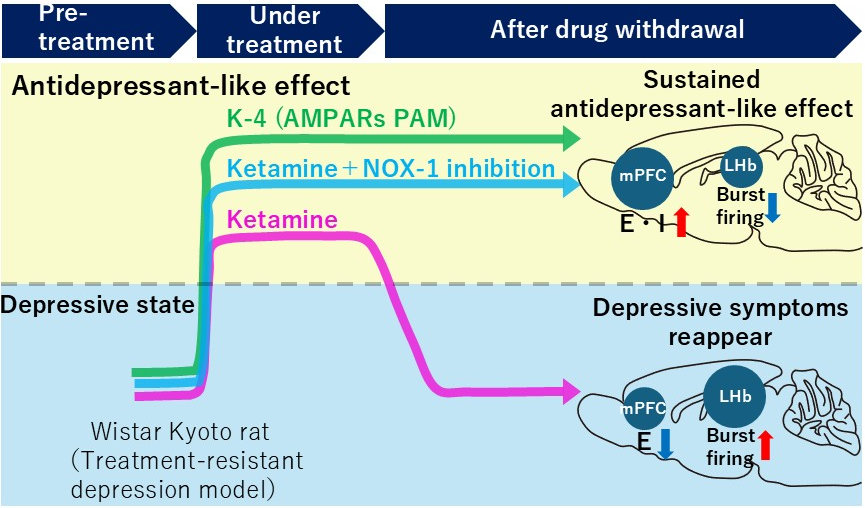
Notably, K-4 produced rapid antidepressant-like effects that persisted for at least 2 weeks after the drug was discontinued, which is well beyond what was seen with ketamine or other AMPAR-boosting drugs. To understand why, the researchers analyzed gene expression in the medial prefrontal cortex (mPFC), a brain region central to mood regulation. They found that rats treated with K-4 exhibited lower levels of NADPH oxidase-1 (NOX-1), an enzyme involved in the production of reactive oxygen species that, in excess, can damage cells and disrupt brain circuit function.
This key finding pointed to NOX-1 as a potential regulator of the duration of antidepressant effects. To test this theory directly, the team combined ketamine with a pharmacological NOX-1 inhibitor and found that this combination significantly extended ketamine’s antidepressant-like effects compared to ketamine alone. They also selectively reduced NOX-1 expression in the mPFC via genetic engineering, achieving the same result.
At the circuit level, both K-4 and ketamine combined with NOX-1 inhibition reduced abnormal burst firing in the lateral habenula, a brain structure strongly linked to negative mood states. Additionally, these interventions restored the balance of excitatory and inhibitory neural circuits in the mPFC, a key mechanism underlying the sustained antidepressant effects. “Our findings shed light on novel molecular and circuit-level mechanisms, providing insights into potential strategies to sustain antidepressant efficacy,” remarks Prof. Takahashi.
Taken together, the results point to two concrete directions for future development in this field: combining ketamine with NOX-1 inhibitors as a strategy to prolong its clinical benefits, and advancing K-4 or similar AMPAR modulators as a new class of longer-lasting antidepressants. “This work may accelerate innovation in the pharmaceutical industry, particularly in the development of glutamate-based antidepressants and precision treatment strategies for TRD,” concludes Prof. Takahashi.
For the many patients for whom current treatments for depression fall short, this type of research represents a meaningful step toward more durable relief.
Despite its undeniable potential, the main drawback of ketamine is that its benefits are short-lived. For most patients, relief fades within days to a couple of weeks after a single dose. While repeated dosing can help, this comes with its own set of practical challenges, such as cost, access to clinics, and concerns about long-term safety. Various strategies have been tested to extend ketamine’s effects, but none have proven reliably effective. Moreover, the biological reasons why ketamine’s antidepressant effects wear off so quickly remain poorly understood.
Against this backdrop, a research team led by Professor Takuya Takahashi from the Department of Physiology, Yokohama City University Graduate School of Medicine, Japan, along with Dr. Waki Nakajima from the same university, investigated the molecular mechanisms in the brain that influence ketamine’s antidepressant effects and duration. Their study, published online in Molecular Psychiatry journal on March 23, 2026, identified a specific molecular target that, when suppressed, can significantly prolong ketamine’s therapeutic benefits.
The team focused on α-amino-3-hydroxy-5-methyl-4-isoxazolepropionic acid (AMPA) receptors (AMPARs)—proteins in brain cells that mediate excitatory communication between neurons and are known to play a role in ketamine’s psychoactive effects. They first developed a novel compound called K-4, a positive allosteric modulator of AMPARs, meaning that it enhances the AMPARs-mediated postsynaptic transmission. Then, they conducted experiments in Wistar Kyoto rats, a well-established animal model of TRD.
Notably, K-4 produced rapid antidepressant-like effects that persisted for at least 2 weeks after the drug was discontinued, which is well beyond what was seen with ketamine or other AMPAR-boosting drugs. To understand why, the researchers analyzed gene expression in the medial prefrontal cortex (mPFC), a brain region central to mood regulation. They found that rats treated with K-4 exhibited lower levels of NADPH oxidase-1 (NOX-1), an enzyme involved in the production of reactive oxygen species that, in excess, can damage cells and disrupt brain circuit function.
This key finding pointed to NOX-1 as a potential regulator of the duration of antidepressant effects. To test this theory directly, the team combined ketamine with a pharmacological NOX-1 inhibitor and found that this combination significantly extended ketamine’s antidepressant-like effects compared to ketamine alone. They also selectively reduced NOX-1 expression in the mPFC via genetic engineering, achieving the same result.
At the circuit level, both K-4 and ketamine combined with NOX-1 inhibition reduced abnormal burst firing in the lateral habenula, a brain structure strongly linked to negative mood states. Additionally, these interventions restored the balance of excitatory and inhibitory neural circuits in the mPFC, a key mechanism underlying the sustained antidepressant effects. “Our findings shed light on novel molecular and circuit-level mechanisms, providing insights into potential strategies to sustain antidepressant efficacy,” remarks Prof. Takahashi.
Taken together, the results point to two concrete directions for future development in this field: combining ketamine with NOX-1 inhibitors as a strategy to prolong its clinical benefits, and advancing K-4 or similar AMPAR modulators as a new class of longer-lasting antidepressants. “This work may accelerate innovation in the pharmaceutical industry, particularly in the development of glutamate-based antidepressants and precision treatment strategies for TRD,” concludes Prof. Takahashi.
For the many patients for whom current treatments for depression fall short, this type of research represents a meaningful step toward more durable relief.
Reference
Title of original paper: NADPH oxidase-1 suppression prolongs the antidepressant-like effect of Ketamine
Journal: Molecular Psychiatry
DOI: 10.1038/s41380-026-03527-1
Journal: Molecular Psychiatry
DOI: 10.1038/s41380-026-03527-1
Additional information
Latest Article Publication Date: 23 March 2026
Conflicts of Interest Statement: Takuya Takahashi is the inventor of a patent application for a novel compound that specifically binds to the AMPA receptor (WO2017006931A1), including K-4. Takuya Takahashi, Tetsu Arisawa, and Waki Nakajima are inventors of a patent application (JP2025-092062, filed on June 2, 2025) based on the findings presented in this study. Takuya Takahashi and Tetsu Arisawa are founders and stockholders of AMPAMETRY, Inc., which holds the exclusive license to use K-4. The authors declare no other potential conflicts of interest.
Conflicts of Interest Statement: Takuya Takahashi is the inventor of a patent application for a novel compound that specifically binds to the AMPA receptor (WO2017006931A1), including K-4. Takuya Takahashi, Tetsu Arisawa, and Waki Nakajima are inventors of a patent application (JP2025-092062, filed on June 2, 2025) based on the findings presented in this study. Takuya Takahashi and Tetsu Arisawa are founders and stockholders of AMPAMETRY, Inc., which holds the exclusive license to use K-4. The authors declare no other potential conflicts of interest.
About Professor Takuya Takahashi from Yokohama City University Graduate School of Medicine, Japan
Dr. Takuya Takahashi is currently a Professor at the Yokohama City University Graduate School of Medicine. His research group primarily studies AMPA receptors, plasticity, synapses, stress hormones, and the comprehensive brain network. He has over 120 publications to his credit. He is also the recipient of several research awards, including the Yokohama City University’s Chairman Award, the National Alliance for Research’s Young Investigator Award, the Tsukahara Nakaakira Memorial Award, and the Commendation for Science and Technology by the Ministry of Education, Culture, Sports, Science and Technology (MEXT). Prof. Takahashi is a highly cited researcher with publications in reputed journals, such as Science, Cell, Scientific Reports, and Nature Medicine.Funding information
This study was supported by JSPS KAKENHI Grant Numbers JP20H05922 (Takuya Takahashi), JP20H00549 (Takuya Takahashi), AMED Grant Numbers JP19dm0207072 (Takuya Takahashi), and the Takeda Science Foundation (Takuya Takahashi and T.Y.). This study was partially supported by AMED Grant Numbers (JP24wm0625304 (Takuya Takahashi) and JSPS KAKENHI Grant Numbers (JP23K10432 (Waki Nakajima), JP25K22755 (Susumu Jitsuki), JP24K02781 (Susumu Jitsuki).For inquiries regarding this press release
Takuya Takahashi
Professor
Department of Physiology, Graduate School of Medicine
Yokohama City University
Professor
Department of Physiology, Graduate School of Medicine
Yokohama City University
Media contact
Yokohama City University, Public Relations Division
koho@yokohama-cu.ac.jp
koho@yokohama-cu.ac.jp
